I once told a scientist about an academic beef. He replied “Academics only care so much because these things matter so little”. This pith correctly characterised 95% of the dramas I would subsequently encounter in research. But academics care so much about geoengineering because it does matter quite a lot, whichever way you see the topic. So if you are annoyed by what I’ve written here, please send me an email - I’ll read it and try my best to respond as thoughtfully as I can.
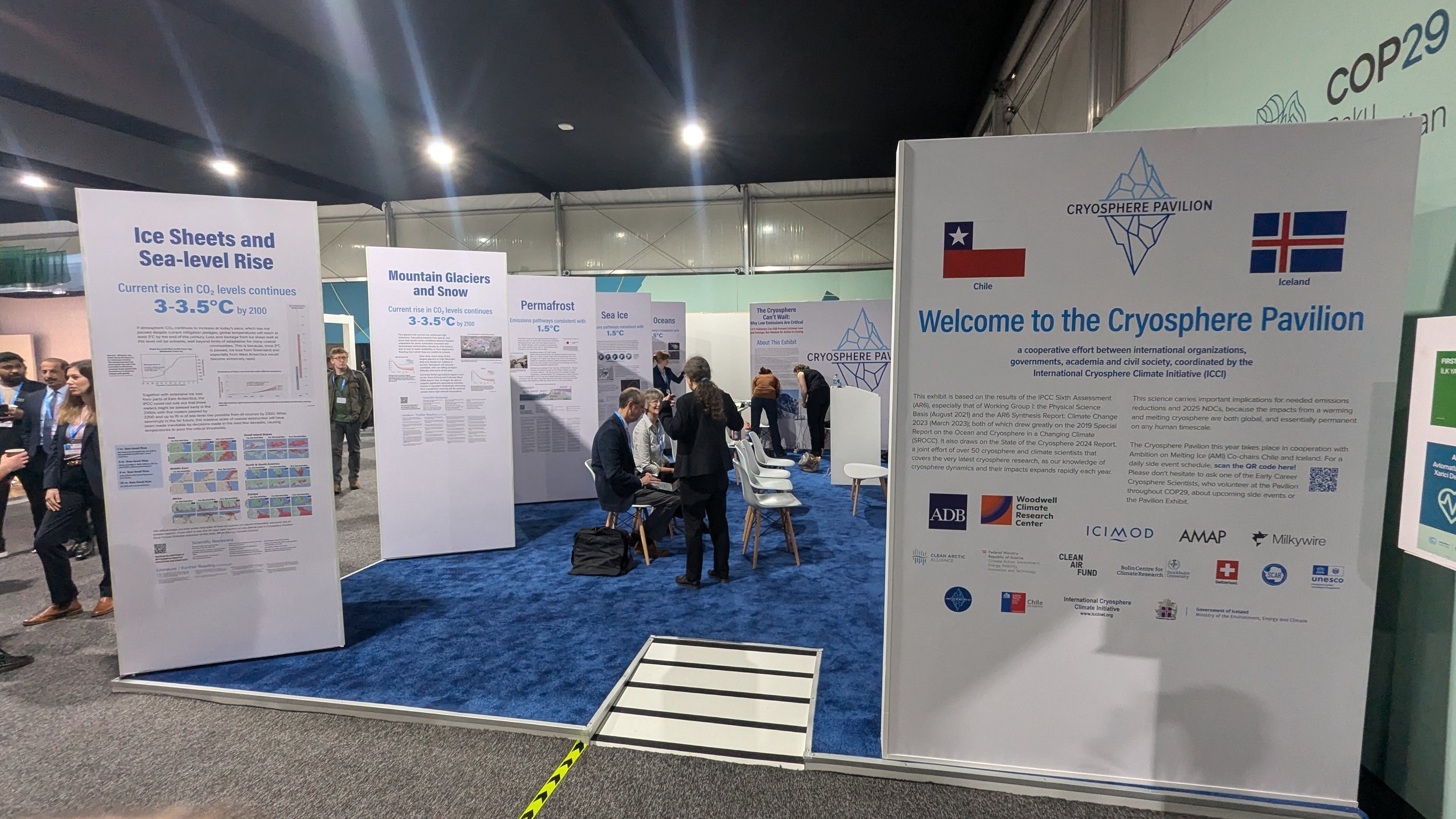
Cryosphere Pavilion at COP in Baku.
I have become pretty familiar with both sides of the sea ice geoengineering research debate. I attended four consecutive UN Conferences of the Parties from 2021 - 2024 with varying levels of affiliation and involvement with the International Cryosphere Climate Initiative, and also travelled to China with them in 2025. I think the ICCI staff do excellent work, and the scientists that they work with do excellent work too. While there is some professional benefit from attending these things, I know first hand that scientists contribute to the ICCI’s cryosphere pavillion because they really care about climate change and its impacts, and they want to make a positive difference to what is quite a dire situation. This collaboration means I know many of the authors on “Safeguarding the polar regions from dangerous geoengineering: a critical assessment of proposed concepts and future prospects” (https://doi.org/10.3389/fsci.2025.1527393), and have spoken with them about the topic. They’re trying to do what’s best for the cryosphere and the people that depend on it.
Arctic Reflections pumping seawater onto sea ice during a field campaign in Qikiqtarjuaq.
I also now know several of the staff of Arctic Reflections, one of the companies that was funded by the UK Advanced Research and Innovation Agency to research sea ice interventions as part of ARIA’s “exploring climate cooling” programme. I also know several of the scientists that Reflections works with. Arctic Reflections invited and paid for me to join their most recent round of fieldwork in Qiqiktarjuaq. Having spent four weeks in a field station overlapping with both legs of their campaigns, it turns out that they also really care about climate change and its impacts, and they want to make a positive difference to what is quite a dire situation. I watched the team from Arctic Reflections do meaningful outreach work in the community too. Much like my observation about scientists going to COP, I sensed that while this was beneficial to their reputations, they felt strongly that it was the right thing to do and they wanted to do it well. They’re trying to do what’s best for the cryosphere and the people that depend on it.
Given my positive experiences with those on both sides of the “argument” about sea ice geoengineering, the conflict between the two poles makes me sad. I think the strength of feeling has degraded the intellectual seriousness of what was already an impersonal and highly online discourse. For the geoengineering research advocates, I suspect the need to gather competitive funding from different sources may have led to mixed messaging on the potential of such interventions. For those against the research, I worry that some empathy has been lost for worried citizens outside academia and the geopolitical sphere who have seen decades of insufficient climate action through conventional channels such as COP, and understandably believe it is no longer possible.
I have further critiques for both sides, but they’re best delivered over a coffee rather than over the internet. My only remaining hope is that all involved reflect on the difficulty of Hume’s is-ought problem. It is the core business of science to discover what is, and it has always been a high-stakes auxiliary proposition for scientists to say what ought to be. The western scientific enterprise is not structured to scrutinise ought statements. As figures of public trust, sometimes scientists have a moral responsibility to do this (drinking water should meet safety standards, climate change is bad, actually). But for the most part, value judgements by scientists require deep consideration of who we speak for, how our cultural values inform our views, and who has been included and excluded from our reasoning processes.
So here is a paper that has only one such ought statement in it: “control [of sea ice geoengineering] should lie with those most directly affected by sea-ice decline”. It broadly captures my views, which lie somewhere between the “Exploring climate cooling” and “Safeguarding” poles. I would be eager to hear your thoughts, either via email or in the comments section of this blog post.
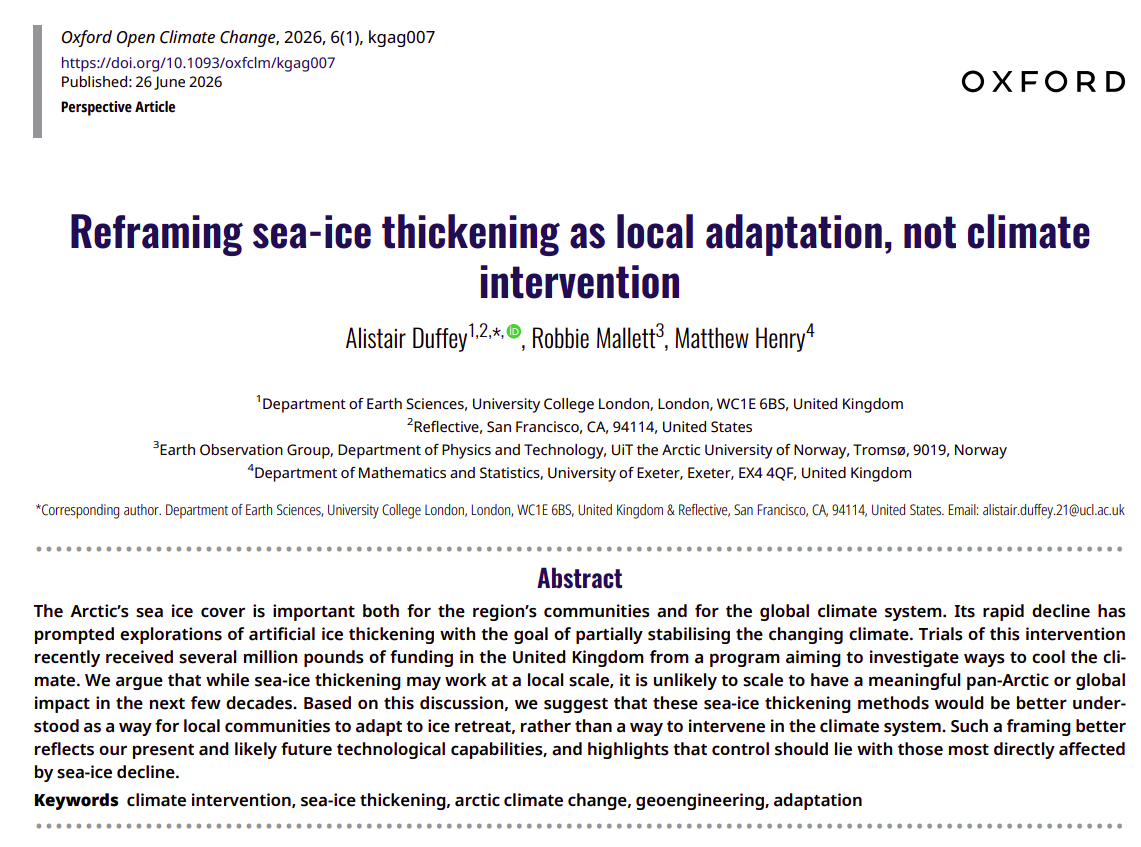
Reframing sea-ice thickening as local adaptation, not climate intervention
https://doi.org/10.1093/oxfclm/kgag007